
AI Summary
- The Problem: The traditional scheduled maintenance window is dead, and offline database migrations cause severe business disruptions that global enterprise operations cannot tolerate.
- The Solution: A continuous Change Data Capture (CDC) dual-state synchronization strategy that streams real-time database mutations to achieve zero-downtime cloud migration.
- 4-Phase Migration Lifecycle: Baseline target schema, run real-time CDC replication, execute shadow read tests, and perform cutover with Reverse CDC as a safety net.
- Flexible Tooling Pathways: Deploy AWS DMS/SCT, Azure DMS, or open-source Debezium with Kafka based on your cloud strategy.
- Pitfall Mitigation: Prevent replication bottlenecks by offloading LOBs to object storage, freezing schemas, temporarily disabling foreign keys, and re-seeding sequences.
- Precision Cutover: Verify near-zero replication lag, reconcile data parity, briefly pause source writes, drain remaining CDC logs, and update connection strings.
By Gemini
For enterprise software architectures, the scheduled maintenance window is effectively dead. When applications power global 24/7 operations, telling business leaders or end users that the system will be offline for a 12-hour database migration over the weekend simply does not fly anymore.
Legacy relational databases, whether running on aging on-premises servers or legacy virtual machines, eventually run into severe scaling limits, rising operational overhead, and prohibitive licensing fees. However, migrating millions of rows, complex schemas, and active transaction streams to modern cloud stores, such as AWS Aurora, Amazon RDS, Azure SQL Managed Instance, or Azure Database for PostgreSQL, presents a real engineering challenge.
Achieving a zero-downtime database migration requires moving away from bulk export tools like pg_dump, mysqldump, or expdp. Instead, the goal is to implement a continuous, dual-state synchronization model. By leveraging Change Data Capture (CDC), software engineering teams can run legacy and cloud databases in parallel until absolute data parity is proven.
The Core Architecture: Change Data Capture (CDC) & Dual-State Synchronization
To migrate a production database without taking applications offline, you cannot simply copy data from Point A to Point B. New writes are constantly hitting Point A while the transfer occurs.
CDC solves this by reading database transaction logs in real time as mutations happen, then transmitting those changes sequentially to the cloud destination.
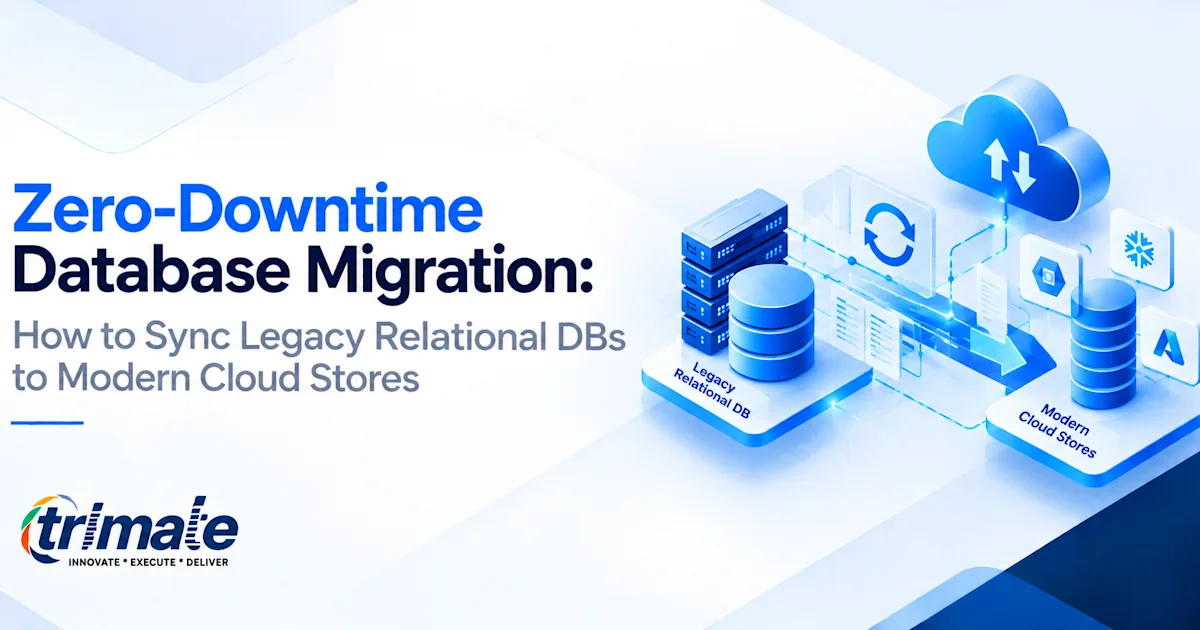
- 1. Initial Baseline: Direct initial snapshot load from Legacy Source DB (SQL Server / Oracle) to Target Cloud DB (RDS / Azure SQL).
- 2. Continuous Write Stream: Real-time log capture (WAL / Binlog / Redo) streamed to the CDC Replication Engine (AWS DMS / Azure DMS / Debezium + Kafka).
- 3. Apply Replayed Mutations: CDC Engine continuously replays captured mutations onto the Target Cloud DB.
The 4-Phase Migration Lifecycle
1. Baseline Schema Mapping & Initial Snapshot
Before moving active transactions, you need to generate the target schema on the cloud database. Proprietary data types, like Oracle NUMBER or SQL Server DATETIMEOFFSETare mapped to cloud-native equivalents. An initial storage-level or table-level baseline snapshot is taken without locking write operations on the primary source.
2. Change Data Capture (CDC) Real-Time Replication
While the baseline snapshot is being loaded into the destination, live production writes continue. The CDC engine monitors transaction logs, such as PostgreSQL Write-Ahead Logs (WAL), MySQL Binary Logs (Binlog), or Oracle Redo Logs, and replays every INSERT, UPDATE, and DELETE operation onto the target cloud database.
3. Dual-Read & Shadow Verification
Once the CDC engine catches up and replication lag drops to near-zero (sub-second latency), the cloud database is fully hydrated. Engineering teams can direct non-critical read traffic, shadow queries, or background analytics tasks to the target store to benchmark query execution plans, indexes, and connection pool behavior under real-world traffic patterns.
4. Cutover & Reverse CDC Safety Net
During the cutover window, application traffic is pointed to the new cloud database. To provide absolute fail-safe protection, Reverse CDC is temporarily enabled, replicating any new writes from the cloud database back to the legacy database for a 48-hour soak period. If an unforeseen critical bug emerges in the cloud infrastructure, traffic can instantly roll back to the legacy database with zero data loss.
Tooling Strategy: AWS, Azure, and Open-Source Pipelines
Choosing the right replication engine depends heavily on your target cloud provider and technical constraints.
| Architecture Track | Key Tools & Services | Primary Target / Use Case |
| AWS-Native | • AWS DMS • Schema Conversion Tool (SCT) | Migrations into Amazon RDS, Aurora, S3, Redshift |
| Azure-Native | • Azure DMS • Data Factory • SSMA | Migrations into Azure SQL, Azure DB for PostgreSQL/MySQL |
| Open-Source Stack | • Debezium • Apache Kafka • Kafka Connect | Custom hybrid architectures, multi-cloud event streams |
1. AWS Cloud-Native Pathway
- AWS Schema Conversion Tool (SCT): Automatically inspects heterogeneous database schemas (such as Oracle or SQL Server to PostgreSQL/MySQL) and converts stored procedures, triggers, views, and data types into target RDS or Aurora dialects.
- AWS Database Migration Service (DMS): Provisions dedicated replication instances that connect source endpoints to target cloud stores. DMS handles both initial full-load migrations and ongoing CDC streams.
- Key Configuration: Make sure the source database enables logical replication or supplemental logging, and configure DMS tasks in Limited LOB Mode or Inline LOB Mode to optimize memory utilization.
2. Azure Cloud-Native Pathway
- SQL Server Migration Assistant (SSMA) & Azure Migrate: Assesses target compatibility, estimates operational costs, and automates schema conversion for workloads moving into Azure SQL Database, Azure SQL Managed Instance, or Azure Database for PostgreSQL/MySQL.
- Azure Database Migration Service (DMS): Supports online migration mode, keeping source databases online while continuously syncing changes to Azure managed database services.
- Key Configuration: For high-throughput PostgreSQL migrations to Azure, configure target instances with compute autoscale and split tables larger than 20 GB across parallel migration threads.
3. Open-Source & Vendor-Agnostic Pathway
- Debezium + Apache Kafka / Kafka Connect: For engineering organizations avoiding proprietary cloud lock-in, Debezium provides log-based CDC connectors for MySQL, PostgreSQL, SQL Server, and Oracle.
- How It Works: Debezium captures low-level database mutation logs and publishes them as structured JSON or Avro events directly into Kafka topics. Kafka Connect consumers then stream these events into any destination store, including cloud relational DBs, search engines, or object storage.
- Key Configuration: Utilize a Schema Registry to enforce contract guarantees as database schemas evolve.
Architectural Tooling Comparison
| Feature / Dimension | AWS DMS + SCT | Azure DMS | Open-Source (Debezium + Kafka) |
| Primary Target | Amazon RDS, Aurora, S3, Redshift | Azure SQL, Azure DB for PostgreSQL/MySQL | Any cloud, hybrid, or on-prem store |
| Log Mining Engine | Proprietary DMS Replication Engine | Azure DMS Online Migration Pipeline | Debezium Engine / Kafka Connect |
| Vendor Lock-in | High (AWS Infrastructure) | High (Azure Infrastructure) | None (Vendor-Agnostic) |
| Setup Complexity | Managed (GUI / Infrastructure-as-Code) | Managed (Azure Portal / CLI) | High (Requires managing Kafka clusters) |
| Best For | Fast migrations into AWS Cloud Ecosystems | Enterprise Microsoft and Azure infrastructure | Custom hybrid architectures & multi-cloud event streams |
Technical Pitfalls & Edge Case Mitigation
While CDC enables seamless data movement, a few edge cases can easily disrupt synchronization if you do not plan for them ahead of time:
1. Large Binary Objects (LOBs / BLOBs)
- The Problem: Inlining massive binary files or raw text blobs inside transaction logs severely chokes CDC parser memory and creates massive replication lag.
- Mitigation: Refactor application logic before migration. Move BLOBs out-of-band directly into Object Storage, such as Amazon S3 or Azure Blob Storage, storing only the resulting file URL reference inside the database table.
2. Schema Evolution During Replication
- The Problem: Running Data Definition Language (DDL) changes, like ALTER TABLE ADD COLUMNon the source database during an active CDC session can crash replication connectors.
- Mitigation: Enforce a strict schema freeze on the legacy database during the active CDC window. If a schema change is required, pause the migration task, apply the DDL on both source and target, and resume replication.
3. Foreign Key Constraints & Execution Order
- The Problem: In-flight CDC messages replaying transactions in parallel can attempt to write child rows before parent records arrive, triggering foreign key constraint violations.
- Mitigation: Temporarily disable foreign key constraints and triggers on the target cloud database during the initial snapshot load and CDC catch-up phase. Re-enable constraints only before final cutover.
4. Sequence & Primary Key Drift
- The Problem: Auto-incrementing primary keys or database sequences, like SERIAL or IDENTITY, can drift out of alignment between source and target during continuous replication.
- Mitigation: Reset and re-seed auto-increment counters on the target cloud database to start well above the highest legacy ID before executing final application cutover.
Step-by-Step Cutover Execution Playbook
Executing the final switchover requires precise coordination between software engineers, database administrators, and DevOps teams:
- Verify Near-Zero Replication Lag: Audit CloudWatch (AWS), Azure Monitor, or Kafka consumer group metrics to ensure replication lag is in the sub-second range.
- Execute Data Reconciliation Checks: Run automated verification scripts comparing row counts, table checksums, and key constraints between legacy and cloud DBs.
- Initiate Brief Write Pause: Place the legacy source database into read-only mode to stop incoming write mutations.
- Drain Replication Buffers: Allow the CDC pipeline 10 to 30 seconds to process all pending transaction log events until source and target reach 100 percent parity.
- Update Connection Strings & Route Traffic: Update internal API gateways, microservice environment variables, or DNS endpoints to point directly to the target cloud database.
- Enable Reverse CDC: Start reverse replication from the cloud database back to the legacy source database to preserve instant rollback capabilities during the initial observation period.
By replacing high-risk bulk database exports with Change Data Capture and continuous dual-state synchronization, enterprise engineering teams can execute complex database modernizations with zero data loss, zero application downtime, and complete operational confidence.
Planning a complex database modernization or legacy cloud migration? Our engineering team is always available to review your migration strategy and help ensure a smooth transition. Let's connect to discuss your architecture.