

AI Summary
- The Problem: Building custom software as a closed, standalone island treats integrations as an afterthought, leading to brittle, siloed codebases and expensive rewrites when new tools or apps are added.
- The Solution: An API-first architecture that defines standardized API contracts before writing code, treating every component as a consumer of core business logic to ensure day-one scale.
- Parallel Development: Enable frontend and backend teams to build simultaneously using mocked API contracts, eliminating bottlenecks and cutting time-to-market.
- Future-Proof Ecosystems: Effortlessly expand to mobile apps, vendor tools, or AI capabilities through simple extension rather than costly re-platforming.
- Automated Data Flow: Connect CRMs, ERPs, and payment gateways at launch to eliminate manual data entry, admin overhead, and fragmented spreadsheets.
- Avoid Architectural Risks: Prevent spaghetti integrations, accumulated technical debt, and isolated departmental data silos caused by retrofitting APIs later.
- Implementation Standards: Maintain live OpenAPI documentation, enforce OAuth2 security via API gateways, and version endpoints properly for backward compatibility.
By Gemini
Building custom software is a massive investment. Yet, many organizations make a critical misstep before a single line of code is written: they design their application as a closed, standalone island, treating integrations as an afterthought to be bolted on later.
When custom software is built without clean API contracts from day one, it quickly becomes a bottleneck. Teams end up trapped in brittle, siloed codebases that require expensive, disruptive rewrites the moment a new tool, mobile app, or partner integration needs to be added.
True scalability requires a different approach. Here is why an API-first architecture is non-negotiable for custom software and how it drives both engineering velocity and long-term business growth.
What is API-First Architecture?
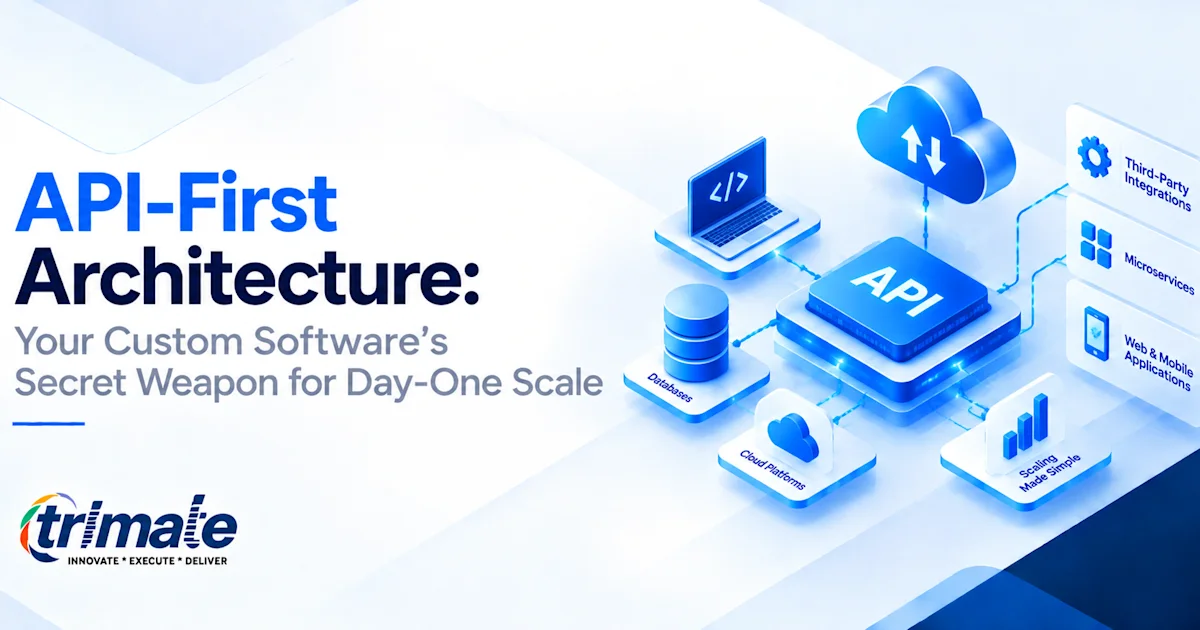
At its core, API-first design flips traditional software development on its head. Instead of building user interfaces and backend database logic first and figuring out how they talk later, development teams design the application programming interfaces (APIs) before anything else.
By defining clear, standardized contracts (using REST or GraphQL) for how data flows between services, you treat every component of your software—whether it is a web frontend, a mobile app, or a third-party CRM—as a consumer of your core business logic.
Why Day-One Integrations Matter (The Business & Technical ROI)
When you prioritize clean integrations from the start, the benefits cascade across your entire organization, from the engineering team to the executive suite.
1. Parallel Development: Cutting Time-to-Market
When APIs are defined upfront, frontend and backend teams do not have to wait for each other. Backend engineers can build out services while frontend teams work simultaneously using mocked API contracts. This eliminates workflow bottlenecks, lets teams ship features faster, and drastically shortens your time-to-market.
2. Future-Proofing Scale: Ready for What’s Next
Markets change quickly, and your software needs to adapt with them. An API-first approach makes it effortless to plug in native mobile apps (iOS & Android), third-party vendor tools, or modern AI capabilities later. Because your core business logic is decoupled from any single user interface, expanding your digital ecosystem requires extension, not re-platforming.
3. Eliminating Operational Bottlenecks from Launch
Modern software rarely operates in a vacuum. By engineering clean data pipelines on day one, you ensure automated, seamless data flow between CRMs, ERPs, payment gateways, and custom dashboards the moment you go live. No manual data entry, no administrative overhead, and no fragmented spreadsheets.
The Cost of Waiting: What Happens When APIs Are an Afterthought?
Treating integrations as a secondary phase introduces severe architectural risks:
- Spaghetti Integrations: Point-to-point connections multiply quickly, creating a tangled web of dependencies where changing one database schema breaks three downstream features.
- Accumulated Technical Debt: Retrofitting APIs into a tightly coupled monolithic codebase requires massive refactoring, burning engineering hours that should be spent building revenue-generating features.
- Data Silos: Departmental tools fail to communicate, forcing your operations teams back into manual workarounds and defeating the original purpose of building custom software.
Best Practices for Implementing an API-First Strategy
To reap the full rewards of an API-first approach, your engineering execution should follow a few core standards:
- Prioritize Documentation: Use tools like OpenAPI (Swagger) to keep API documentation living, accurate, and easily accessible for internal developers and external partners alike.
- Enforce Security Early: Establish robust authentication and authorization protocols (such as OAuth2) and route traffic through a secure API gateway from day one.
- Design for Backward Compatibility: Treat your APIs as permanent products. Version your endpoints properly so future updates never break existing integrations or client applications.
Conclusion
Building scalable software isn't about chasing technology trends—it requires a disciplined, end-to-end approach. By establishing clear architecture, validating with an MVP, and baking API-first integration into your custom web and mobile platforms right from day one, you build a sustainable digital asset rather than future technical debt.
Ready to build software designed for enterprise scale? Contact our engineering team today to schedule an IT Architecture & Fullstack Development Audit.